Silicon Valley's New Order: Jensen Huang Ascends as Michael Dell's Reign Wanes, Trump's Cheers Echo in the Background
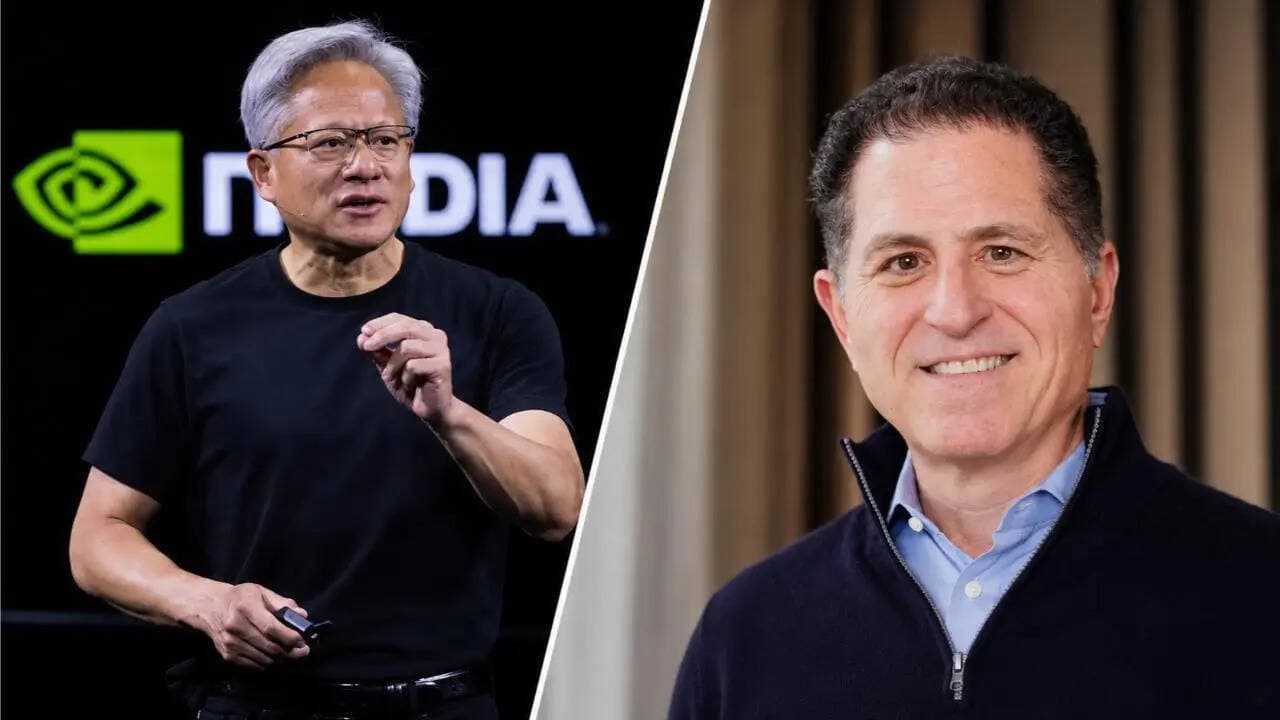
"Nvidia's meteoric rise, catapulting Jensen Huang past Michael Dell in wealth, signifies a tectonic shift in the tech landscape. This isn't just about money; it's about control of the future. The former President's acknowledgment adds a layer of political intrigue, highlighting the deep intertwining of business and power. Prepare for a restructuring of the technological elite, with the architects of AI claiming their rightful throne."
Key Takeaways
- •Nvidia's ascendance over Dell marks a significant shift in the tech industry, driven by the dominance of AI.
- •The former President's acknowledgment of Huang's success highlights the intertwined relationship between business and politics.
- •This moment echoes the transition of the computer age, indicating potential consolidation and competition in the AI market for years to come.
The flickering screens of Wall Street’s trading floors seemed to hum a different tune this week. Whispers of a seismic change, a disruption in the established order of the tech titans, rippled through the marbled halls of power. It wasn't the Dow Jones Industrial Average dipping, nor a particularly aggressive acquisition. It was the stark, undeniable reality flashing across the financial trackers: Jensen Huang, the CEO of Nvidia, had eclipsed Michael Dell, founder of Dell Technologies, in the ever-shifting game of net worth. The news, delivered with a casual air by The Times of India, was more than just a headline; it was a shot across the bow, a signal that the future of computing, and the fortunes it would generate, had irrevocably changed hands.
The Lede: A New King is Crowned
Imagine, for a moment, the hushed anticipation before a championship fight. The crowd, a mix of seasoned veterans and starry-eyed hopefuls, waits with bated breath. The air crackles with tension, a potent cocktail of ambition and fear. In one corner, the incumbent, Michael Dell, a name synonymous with personal computing for decades, a titan who had weathered storms and built an empire on the back of Moore’s Law. In the other, Jensen Huang, a relative newcomer to the very top echelons, a visionary whose company, Nvidia, had quietly, relentlessly, built the engines of the next technological revolution: artificial intelligence.
The bell rang. The financial markets declared Huang the victor, and with it, a new era. The victory wasn't just a matter of balance sheets and stock valuations; it was a symbolic coronation. The shift from the commoditized world of PCs to the specialized, high-powered realms of AI, data centers, and advanced graphics processing had begun.
The Context: The Long Game of Silicon Valley
To fully grasp the significance of this moment, we must rewind, not just to the present, but to the very genesis of the modern technology era. Michael Dell's rise, mirroring the ambitions of other pioneers, built a formidable empire. His vision was clear: to democratize computing, make it accessible and affordable for everyone. His strategy was equally straightforward: efficient supply chains, direct sales, and relentless cost-cutting. His triumph was building a personal computer company that became a household name. He conquered the personal computing market, setting up his company as one of the major players in the market.
But the market never sleeps. While Dell solidified its position, a different ecosystem was taking shape. The rise of the internet, the explosion of data, and the need for ever-increasing computing power created a new market niche. This niche belonged to the graphical processing unit, or GPU, and Nvidia, under Huang's leadership, was ready to exploit it. They didn't just build faster graphics cards; they engineered the raw power for artificial intelligence, machine learning, and high-performance computing.
The dealmaking and acquisitions that characterized Dell's strategy, while impressive, had a fundamentally different purpose than Nvidia’s. While Dell was expanding, consolidating, and streamlining, Nvidia was playing a different game entirely. They were betting on the future, investing heavily in research and development, and forging partnerships that would unlock the potential of AI and other data-intensive technologies. Nvidia, in its strategy, bet on the future. They didn't need to control every aspect of the technology ecosystem. They had a single goal: dominate the specialized chips and processors that would power the coming era. That was their path to becoming a market leader.
This is where the political undercurrents come into play. While the details of any personal interactions are, of course, unknown, former President Trump's acknowledgment of Huang's success serves as a potent reminder of the complex relationship between business and politics. Support, tacit or overt, can translate into favorable regulations, access to government contracts, and a boost in public perception. This is not to suggest any explicit quid pro quo, but the visibility – the implied endorsement – is valuable in a cutthroat, highly competitive global market.
The Core Analysis: The Numbers, the Players, and the Hidden Agendas
The raw numbers tell the most compelling story. Nvidia's market capitalization has soared, fueled by insatiable demand for its GPUs. This is the tangible evidence of Huang’s success. While Dell’s stock performance has been steady, it is a testament to stability rather than explosive growth. The difference reflects the divergent paths of the two companies: Dell, a mature and established player in a saturated market; Nvidia, a rocket ship hurtling towards an almost limitless horizon.
Who wins and who loses? The immediate beneficiaries are Nvidia shareholders, Huang, and his core leadership team. But beyond them, the winners are those who understand where the world is going. The AI developers, the data scientists, the cloud computing providers – all are riding the wave of Nvidia's success. The losers are the laggards, those who failed to anticipate the shift and adapt to the new reality. This would include companies that relied on outdated technologies, those who didn't invest in AI and deep learning, and those whose strategies were focused on short-term profits instead of long-term innovation.
Hidden agendas abound, of course. Dell's long-term strategy will likely involve diversifying into high-performance computing, perhaps by partnering with or acquiring companies in the AI space. But it will be an uphill battle, attempting to regain lost ground. Nvidia, for its part, has an agenda driven by Huang. Huang will keep expanding the reach of its technologies, consolidating partnerships, and investing in new frontiers such as robotics and autonomous vehicles. The overarching goal is clear: to become the undisputed king of AI computing, the gatekeeper of the future.
The Macro View: Reshaping the Landscape
This single piece of news about Huang surpassing Dell is representative of an even larger trend. This reshuffling of the ranks is emblematic of a broader shift in the tech landscape. The old guard, those who dominated the PC era, are gradually giving way to the new generation, the architects of AI, cloud computing, and advanced data processing. The future will be defined by those who control the flow of information, and the processing power that drives it.
This moment echoes the late 1990s. This is when Steve Jobs returned to Apple, and the company was on the brink of collapse. He had a vision that led to the development of the iPod, the iPhone, and the iPad. He understood that software, hardware, and design were the keys to unlocking a massive, untapped market. Similarly, Huang saw the potential of AI long before the rest of the world. Now, he's reaping the rewards.
The implications are far-reaching. As Nvidia's influence grows, the balance of power in Silicon Valley will shift. We can expect to see consolidation, strategic alliances, and intense competition for talent and resources. It's a game of survival, and only the most adaptable will thrive. This shift will also impact geopolitics. The countries that lead in AI and advanced computing will have a significant advantage in areas like military defense, economic competitiveness, and scientific innovation.
The Verdict: A Future Forged in Silicon
Here’s the seasoned prediction: In the next year, Nvidia's influence will continue to grow, with its market cap potentially reaching even greater heights. Dell, by contrast, will face a challenge to adapt to a changing market, as it continues to restructure. In five years, Nvidia will be the dominant force in AI hardware, shaping the future of computing, and driving innovation across multiple industries. Dell, while remaining a significant player, will occupy a smaller slice of the pie.
In ten years, the world will likely be unrecognizable. AI will be integrated into every aspect of our lives, from healthcare and education to transportation and entertainment. Nvidia will be at the core of this transformation, its chips powering the most advanced technologies, and its CEO will be a global icon, a modern-day visionary who changed the world.
The dethroning of Michael Dell and the rise of Jensen Huang is not merely a financial anecdote. It's a sign of a fundamental shift. It’s a moment that will be studied for years to come. In the relentless world of technology, yesterday’s giants are today’s footnotes. Only the most forward-thinking and adaptable will secure their place in the next chapter of technological history. And right now, the future appears to be wearing a green and black Nvidia badge.
Sources & further reading
Related analysis
- Amazon's Ascent: Navigating the Tides of Triumph – A Veteran's Guide to Playing the Stock
- Silicon Valley's Red Flag: Laura Loomer's Nvidia Assault – Is Jensen Huang's China Connection the Next Tech Scandal?
- Microsoft's Masterstroke: Why Wall Street Is Blind to the True Value of MSFT (And Why That's Their Advantage)
- Data Center Gold Rush: Why Infrastructure Construction Stocks Are the Only Game in Town
- Nomura's Walmart Exit: A Canary in the Coal Mine for Retail's Future?
- Jabil's AI Infrastructure Gamble: A High-Stakes Bet on the Future or a Mirage of Growth?