Huang's Ascension: How Nvidia's Commencement Address Signals the Dawn of AI Dominance
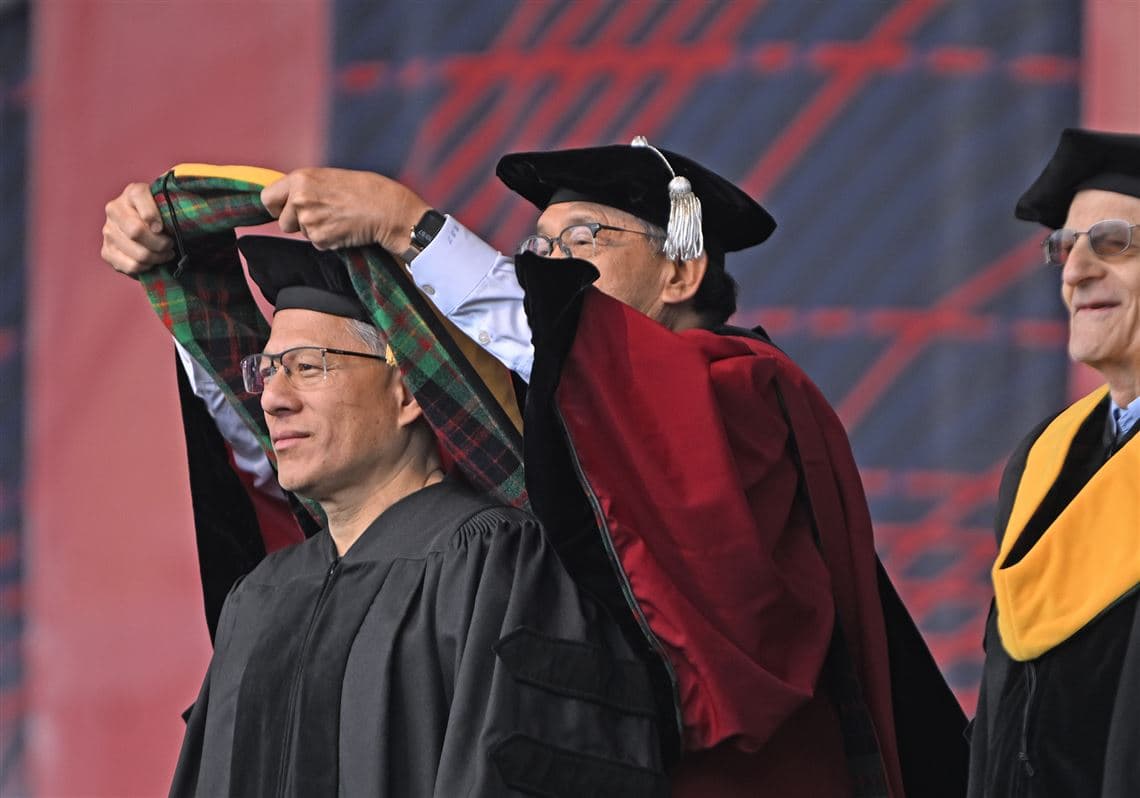
"Jensen Huang's Carnegie Mellon commencement address wasn't just a speech; it was a declaration. It marked the formal coronation of Nvidia as the undisputed king of the AI era, a move that will send shockwaves through Silicon Valley and beyond. This is not about semiconductors; it's about the very fabric of computing, and Huang is positioning his company to be the master weaver."
Key Takeaways
- •Nvidia is positioned as the dominant player in the AI era.
- •Jensen Huang's strategic foresight and investment in GPUs proved crucial.
- •The speech signals Nvidia's intent to shape the future of computing and influence global affairs.
The air crackled with anticipation, a tangible buzz that transcended the usual commencement day excitement. The sun beat down on the manicured lawns of Carnegie Mellon University, but the real heat was emanating from the auditorium. Inside, a capacity crowd – graduates, families, faculty, and a smattering of industry titans – awaited the arrival of Jensen Huang, co-founder and CEO of Nvidia. This wasn't just another graduation ceremony; it was a coronation, a passing of the torch, a signal fire illuminating the future of technology.
The Lede: A Stage Set for the AI Revolution
The scene was almost biblical. Huang, a figure seemingly carved from the silicon itself, strode onto the stage, a mischievous glint in his eyes. His signature leather jacket, a defiant emblem of his iconoclastic spirit, caught the light. He wasn't there to simply congratulate graduates; he was there to deliver a prophecy. To lay bare the contours of a world irrevocably reshaped by artificial intelligence, a world where Nvidia, his creation, would reign supreme. The applause was deafening, a roar that washed over the assembled masses, a testament to the man and the machine he had built.
The choice of Carnegie Mellon was no accident. This hallowed institution, a breeding ground for some of the world's brightest minds in computer science and AI, represented the very foundation upon which Nvidia's empire was built. Huang understood the power of symbolism. He knew that the commencement address wasn't just about inspiring the graduating class; it was about galvanizing the entire industry, sending a clear message to competitors, investors, and governments alike: Nvidia is here, and it’s here to stay.
The Context: From Graphics Cards to God-Level Computing
To fully grasp the significance of Huang's pronouncements, one must understand the journey. It's a journey that began not with AI, but with graphics. Nvidia initially built its empire on the back of gaming, a market they revolutionized with their innovative graphics processing units (GPUs). These GPUs, designed to handle the complex calculations required for rendering lifelike images in video games, proved to be the perfect architecture for a new paradigm: artificial intelligence. While competitors were focused on central processing units (CPUs), Nvidia saw the future and bet big on parallel processing, a characteristic that made GPUs ideally suited for the massive datasets and complex algorithms that underpin AI.
This strategic pivot, made years ago, is now paying off handsomely. It wasn't simply a matter of technical prowess; it was about foresight. Huang recognized the impending convergence of AI, high-performance computing, and a relentless thirst for data. He invested billions in research and development, building a vertically integrated ecosystem that encompasses everything from chip design and manufacturing to software and cloud services. This forward thinking is what set them apart and allowed them to build a moat that others are struggling to cross. Remember the dot com bust? Many firms thought the internet was a fad, and they missed the boat. Huang was on the boat the whole time.
The acquisition of Mellanox Technologies in 2020 for a cool $6.9 billion was another pivotal moment, allowing Nvidia to dominate the high-speed interconnect market, essential for connecting the massive networks of GPUs that power AI. This was a masterstroke, a move that further solidified their control over the entire value chain. Huang was not content to be just a chipmaker; he was building a data center empire, and he was doing it with surgical precision.
The Core Analysis: Winners, Losers, and Hidden Agendas
The commencement address served as a not-so-subtle unveiling of Nvidia's dominance. Huang wasn't just talking about the future; he was actively shaping it. He emphasized the importance of AI in everything from medicine and climate change to robotics and creative expression. But the subtext was clear: Nvidia is the key. They possess the tools, the technology, and the vision to unlock this potential. The numbers speak for themselves. Nvidia's stock has skyrocketed in recent years, fueled by explosive revenue growth in the data center market, now the company's biggest money maker. Their GPUs are the de facto standard for AI training and inference, and they are aggressively expanding into new markets, including autonomous vehicles and the metaverse.
The winners are obvious: Nvidia, its shareholders, and those who have hitched their wagon to the company’s star. But what about the losers? The traditional CPU manufacturers, Intel in particular, are playing catch-up, struggling to compete in a market they once dominated. The competition in this field is fierce. The recent announcements from AMD and other players is a constant reminder that Nvidia needs to keep innovating. It will be interesting to watch the moves of the major cloud providers as they vie for dominance in the AI landscape.
Hidden agendas? There are always hidden agendas. Huang is not just building a company; he is building a movement. He’s fostering an ecosystem around his technology, creating a network effect that will be incredibly difficult to break. By providing the essential ingredients for AI development, he is effectively controlling the recipe. This kind of power is unprecedented, and it comes with enormous responsibilities. It is no accident that governments around the world are now paying close attention to Nvidia’s activities, and for good reason.
The "Macro" View: Reshaping the Landscape
Huang's speech at CMU isn't just about Nvidia; it's about the fundamental shift in the technological landscape. We are witnessing a transition away from the old guard of computing (Intel, Microsoft, etc.) and towards a new paradigm driven by AI and data. This shift will have far-reaching implications, impacting everything from education and healthcare to defense and entertainment. We are at the dawn of the AI revolution, and Nvidia is the sun god.
The implications are staggering. Countries that embrace AI and develop their own capabilities will thrive; those that lag behind will be left in the dust. The world is getting smaller as AI-powered technologies shrink distances and increase communication speeds. The nature of work is changing, and the skills needed to succeed in the future economy are also changing. We are going to see things we can't imagine, and the companies that can pivot, learn and create will be the ones who lead the way.
This moment echoes Jobs in '97, when he returned to Apple and outlined a clear vision to save a company on the brink of collapse. Huang, too, is a visionary, but he's playing a different game. He's not just saving a company; he's orchestrating a global technological transformation. His every move is calculated, every word is weighed. He is a conductor, and the orchestra is the future.
The Verdict: The Next Decade and Beyond
My prediction? Nvidia's dominance will continue, perhaps even solidify, for the foreseeable future. The company will face challenges, certainly. Competition will intensify, and regulatory scrutiny will increase. But Huang has built something truly special, a company with a strong culture, a talented workforce, and a clear vision. They have become the indispensable platform for the AI age.
**1-Year Outlook:** Expect continued strong financial performance, with the stock price likely to remain high. Nvidia will face some supply chain challenges and possibly some backlash from their competitors. They will also make further inroads into new markets, including the automotive space and AI for scientific research.
**5-Year Outlook:** Nvidia will continue to dominate the AI landscape, but competition will intensify. Expect acquisitions, strategic partnerships, and ongoing innovation in chip design, software, and cloud services. Expect increased pressure from governments and regulators, who will seek to exert more control over the company's activities. The Metaverse will become a real part of Nvidia's business, with the firm poised to capitalize.
**10-Year Outlook:** Nvidia will become even more entrenched, assuming they do not stumble on their own success. They will have a core position in many areas. Their influence will extend beyond technology, shaping policy and influencing global affairs. The company will be a global power player, a force to be reckoned with. The real question is: who, or what, will take them on? History tells us that the bigger they are, the harder they fall. But Huang seems to have learned the lessons of history well. Nvidia will be facing unprecedented challenges, but will have made the fundamental shifts required to continue to win.
Jensen Huang's commencement speech was a declaration of victory, a blueprint for the future. He is a man who saw the future, and bet the farm on it. His legacy is being written in silicon, and its story is only just beginning.
Sources & further reading
Related analysis
- Amazon's Ascent: Navigating the Tides of Triumph – A Veteran's Guide to Playing the Stock
- Silicon Valley's Red Flag: Laura Loomer's Nvidia Assault – Is Jensen Huang's China Connection the Next Tech Scandal?
- Microsoft's Masterstroke: Why Wall Street Is Blind to the True Value of MSFT (And Why That's Their Advantage)
- Data Center Gold Rush: Why Infrastructure Construction Stocks Are the Only Game in Town
- Nomura's Walmart Exit: A Canary in the Coal Mine for Retail's Future?
- Jabil's AI Infrastructure Gamble: A High-Stakes Bet on the Future or a Mirage of Growth?